
AI accelerates quantum computing with atom array assembly
Researchers use AI to optimize the assembly of atom arrays for quantum computers, demonstrating speed with a Schrödinger's cat animation.
Artificial intelligence (AI) is now aiding scientists in optimizing the assembly of neutral atom arrays, a key component for future quantum computers. A team led by physicist Jian-Wei Pan at the University of Science and Technology of China has demonstrated this breakthrough, publishing their findings in Physical Review Letters^1^.
The Quantum Computing Challenge
Quantum computers rely on qubits, which can exist in a superposition of states (1 and 0 simultaneously). Unlike classical bits, qubits must be entangled for calculations. Neutral atoms, such as rubidium, are promising qubit candidates due to their long-lasting quantum states. However, arranging these atoms into precise grids has been a slow and complex process—until now.
AI to the Rescue
The team trained an AI model to calculate the optimal laser patterns needed to rearrange rubidium atoms into 2D and 3D configurations. The AI achieved remarkable speed, assembling 2,024 atoms in just 60 milliseconds—far faster than previous methods^2^.
 Credit: Getty
A Playful Demonstration: Schrödinger's Cat
To showcase the AI's capabilities, the team created a miniature animation of Schrödinger's cat using the atom array. The AI-directed laser pulses moved atoms to form the iconic quantum physics symbol, with the atoms emitting light to become visible.
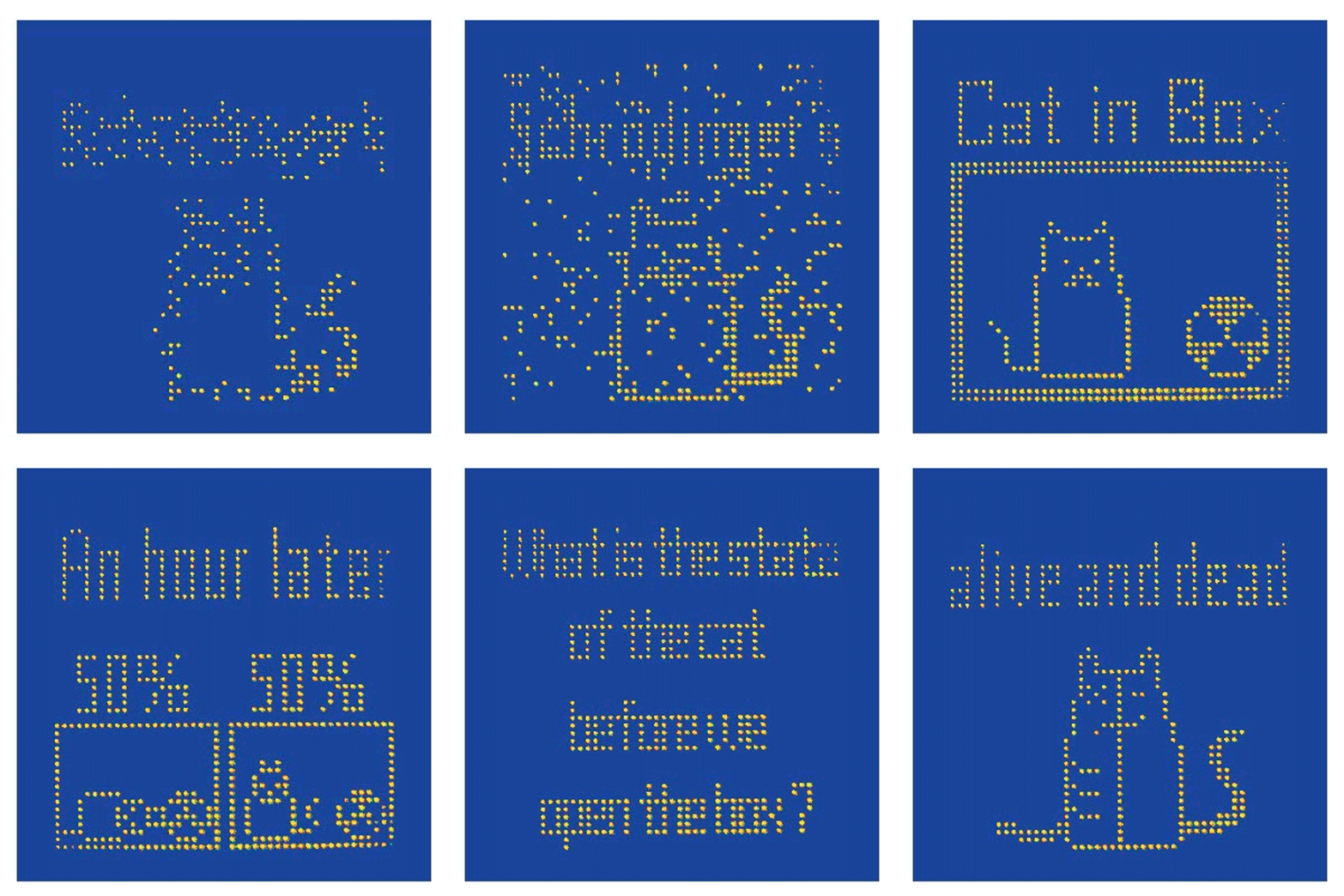 Credit: R. Lin et al., Phys. Rev. Lett.
Scaling Up Quantum Systems
Traditional methods for creating holograms to arrange atoms are time-consuming, especially as arrays grow larger. Mark Saffman, a physicist at the University of Wisconsin–Madison, praised the work, noting its potential to streamline quantum computing development.
This breakthrough highlights AI's growing role in scientific innovation, from paper writing to . As quantum computing advances, AI could be the key to overcoming scalability challenges.
Related News
AI Scientists Could Win Nobel Prizes by 2050
Researchers debate whether autonomous AI scientists could achieve Nobel-worthy breakthroughs by mid-century, with some predicting success as early as 2030.
OpenAI CEO discusses AI ambitions with UAE president
OpenAI's CEO met with UAE's president to discuss AI cooperation and the country's goals in artificial intelligence research and applications
About the Author

Dr. Lisa Kim
AI Ethics Researcher
Leading expert in AI ethics and responsible AI development with 13 years of research experience. Former member of Microsoft AI Ethics Committee, now provides consulting for multiple international AI governance organizations. Regularly contributes AI ethics articles to top-tier journals like Nature and Science.